Agricultural Phenotyping Robot Chassis: A High Ground-Clearance Research Platform for Mid- to Late-Stage Crops
In the context of the continuous development of smart agriculture and crop science, the requirements for field robotic platforms in agricultural research are evolving: they must not only be “able to operate in the field,” but also “scalable, reusable, and capable of long-term support for research projects.”
Focusing on the operational needs of mid- to late-stage tall crops, phenotypic data collection, and interdisciplinary research, we have developed this Agricultural Phenotyping Robot Chassis — a high ground-clearance, adjustable, and modular agricultural robotic mobile platform designed with a core focus on research and engineering applications.
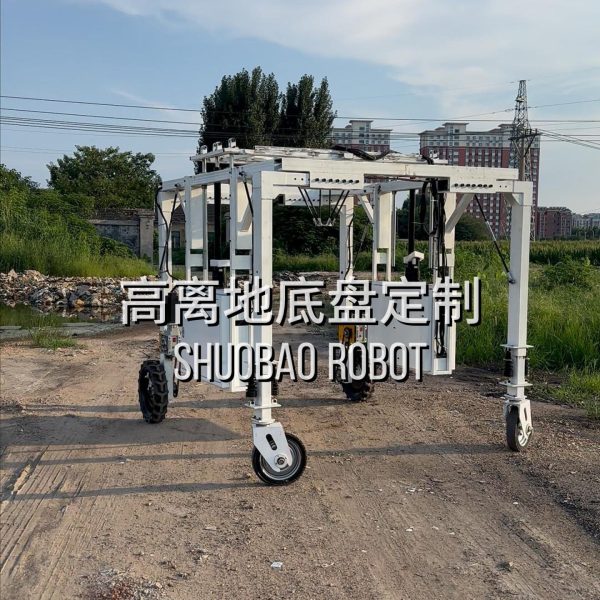
2.6-meter High Ground Clearance Design: Supporting Phenotyping Research for Mid- to Late-Stage Crops
After crops such as corn, sugarcane, and sorghum enter the mid- to late-growth stages, traditional low-clearance platforms struggle to operate between rows for continuous fieldwork, severely limiting the window for phenotypic data collection.
This chassis adopts a 2.6-meter high ground clearance structural design, enabling stable traversal between crop rows without disturbing plant growth, allowing:
Continuous phenotypic data collection for mid- to late-stage crops
Row-interception detection and monitoring of tall crops
Reducing the risk of crop damage while ensuring experimental consistency
This capability enables researchers to obtain more complete and continuous field data during critical growth stages.
Front Differential Drive and Rear Caster Wheel Configuration: Balancing Stability and Maneuverability
For typical agricultural scenarios such as uneven field terrain and frequent turning at field edges, the chassis adopts a combination of front differential drive and rear caster wheels in its mobility system:
The front differential drive provides reliable traction and straight-line stability.
The rear caster wheels reduce the turning radius and improve turning efficiency at field edges.
Adaptable to irregular field plots and narrow-row working environments.
This configuration ensures platform stability while enhancing overall maneuverability, making it well-suited for long-term, repetitive research and experimental tasks.
Adjustable Wheelbase and Track Width: One Platform for Multiple Crops and Experimental Designs
Agricultural research often involves multiple crops, varying row spacing, and diverse experimental designs, placing extremely high demands on equipment versatility.
The chassis of this agricultural phenotyping robot supports:
Adjustable Wheelbase: Compatible with various sensor layouts and functional modules
Adjustable Track Width: Flexibly adapts to different crop row spacings and planting patterns
By adjusting structural parameters, the same chassis platform can serve different crops, regions, and experimental designs, significantly improving equipment utilization.
Modular Upper and Lower Platform Architecture: Reserved Space for Research and Engineering
Unlike off-the-shelf robots with fixed functions, this chassis is designed from the outset with a strong emphasis on: platformization and modularity.
Upper Platform:
Phenotyping sensors (RGB, multispectral, LiDAR, etc.)
Work or experimental modules (e.g., corn detasseling mechanisms, monitoring devices)
Lower Platform:
Power system and energy module
Controller, drive units, and communication interfaces
This layered upper–lower architecture enables research teams to perform secondary development, rapid modifications, and functional expansion based on project needs, allowing the platform to support both phenotyping and specific operational validation, such as corn detasseling
Typical Research and Engineering Applications
This agricultural phenotyping robot chassis can serve as a mobile base platform for various projects, including but not limited to:
High-throughput crop phenotyping research
Monitoring of crop growth and traits during mid-to-late growth stages
Research and validation of a corn detasseling robot
Testing of agricultural robot algorithms and perception systems
Construction of field experimental platforms for agricultural research institutions
By replacing or integrating different modules, the platform can be flexibly adapted to various research objectives, including phenotyping, detasseling, crop protection, and inspection tasks.
Engineering Platform for Research Institutions and Large Enterprises
We position this product as infrastructure for agricultural robotics research and engineering development, rather than a single-purpose device. In the design process, we focus on:
Engineering-grade structural reliability
Customizability of parameters and interfaces
Stable operation for long-term field experiments
Ease of system integration and secondary development
This chassis is suitable for agricultural research institutions, agricultural equipment companies, and smart agriculture project teams as a long-term, general-purpose mobile platform, while also meeting specific operational needs such as corn detasseling.
As agricultural research advances toward greater precision and digitalization, the ability to acquire phenotypic data is becoming a critical foundational capability. The backbone supporting such research is often not a single algorithm or sensor, but a stable, open, and scalable robotic chassis platform.
This agricultural phenotyping robot chassis is designed for this purpose, supporting both research experiments and specific operational validation, such as corn detasseling, crop protection, and inspection applications.
For detailed technical specifications, application cases, or customized solutions, please feel free to contact us to discuss your research or engineering needs in detail.