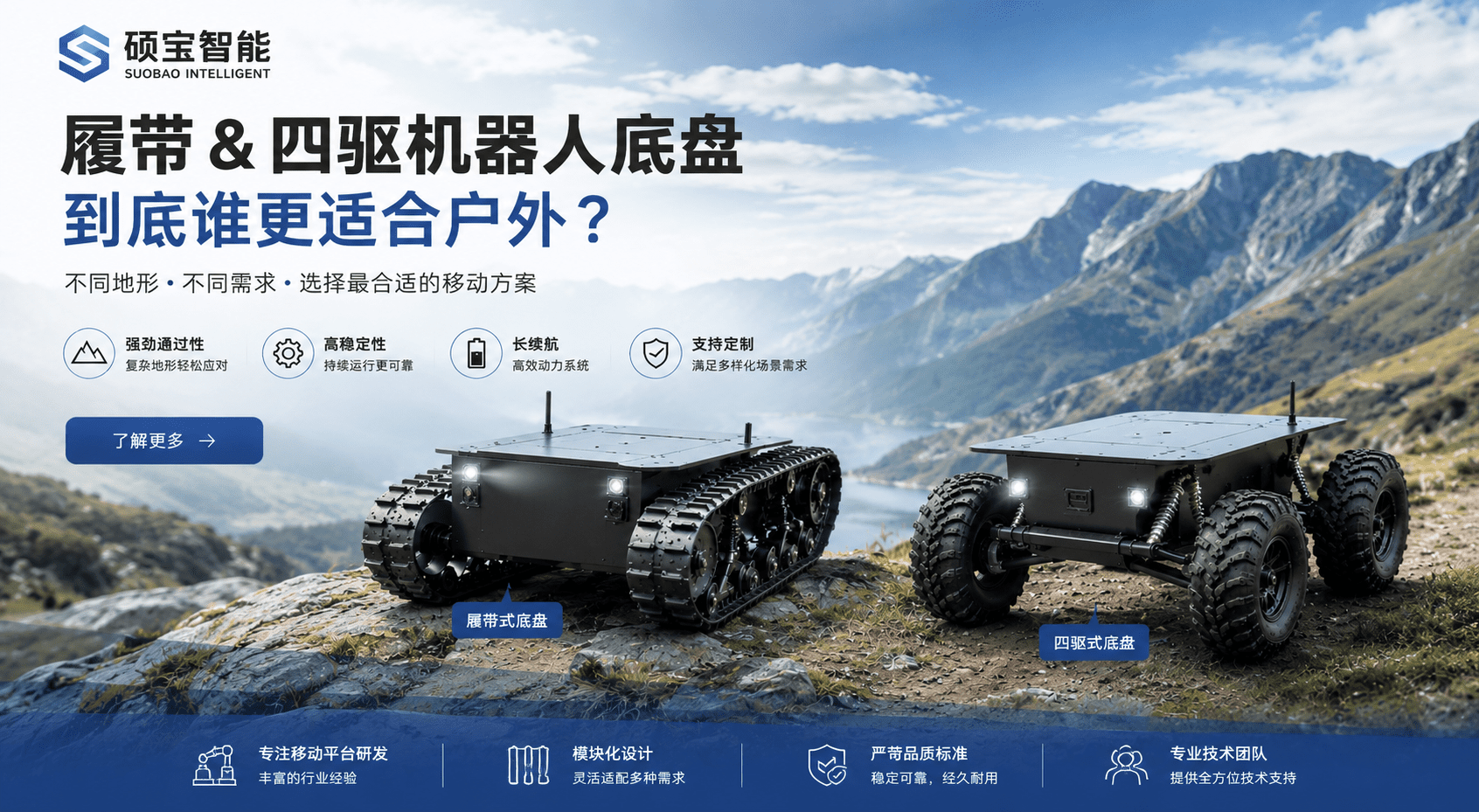
Tracked vs. 4WD Robot Chassis: Which Is Better for Outdoor Robots?
Many robot projects perform perfectly in the lab.
But once they move outdoors, problems start to appear:
- Wheel slipping
- Getting stuck
- Obstacle crossing failures
- Poor steering
- Motor overload
- Unstable operation on grass and mud
In many cases, the problem is not the algorithm.
In many cases, the problem is not the algorithm.
So how do you choose between tracked and 4WD robot chassis?
In reality, there is no universally better solution.
What matters most is the environment your robot needs to handle.
Why Many Outdoor Robots Fail in Real Environments
Many robotics teams focus heavily on:
- LiDAR systems
- AI recognition
- ROS integration
- Autonomous driving algorithms
But once the robot enters real outdoor environments, they realize:
Terrain is often more challenging than algorithms.
- Muddy roads
- Grassland
- Orchards
- Gravel paths
- Slopes
- Soft ground
- Ditches and uneven obstacles
These environments directly determine whether the chassis structure is suitable. Tracked and wheeled platforms follow two fundamentally different mobility approaches.
Advantages of Tracked Robot Chassis
The biggest advantage of tracks is theirlarge ground contact area.
- Lower ground pressure
- Better traction
- Superior terrain adaptability
Ideal for:
- Muddy roads
- Soft soil
- Snow
- Mountain areas
- Steep slopes
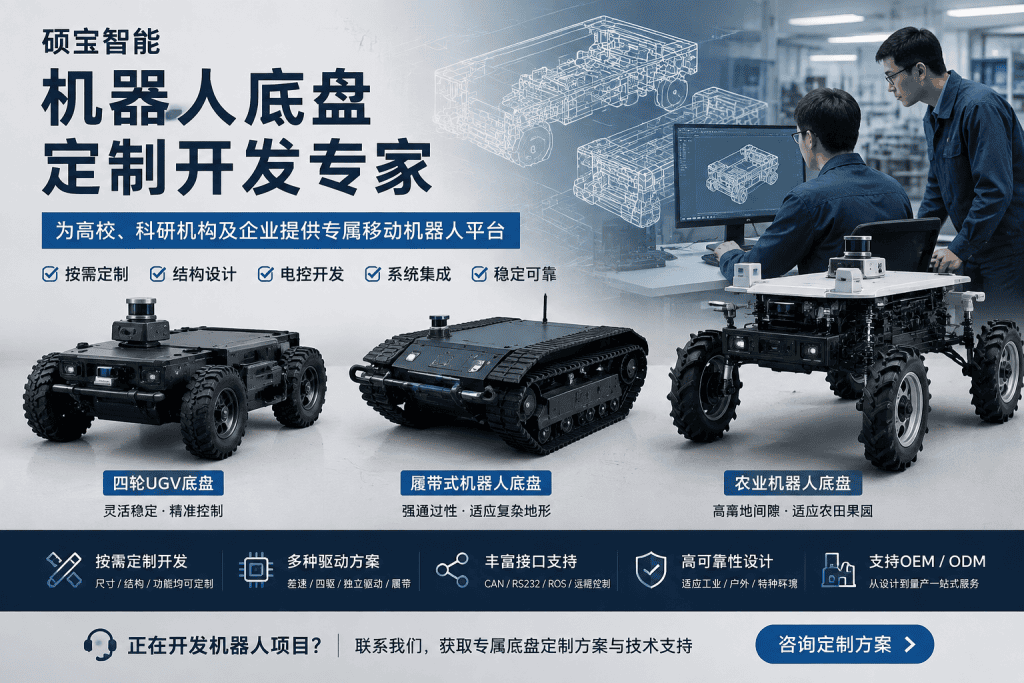
Agricultural robots, inspection robots, and firefighting robots often use tracked chassis because they are less likely to get stuck.
Common Applications for Tracked Robots
- Agricultural robots
- Inspection robots
- Mountain transport robots
- Firefighting and EOD robots
- Extreme environment robots
Disadvantages of Tracked Chassis
- High steering resistance:Differential steering causes higher friction and power loss
- Lower speed: Optimized for terrain capability rather than efficiency
- More maintenance: Track tensioning and wear increase maintenance costs
Advantages of 4WD Wheeled Robot Chassis
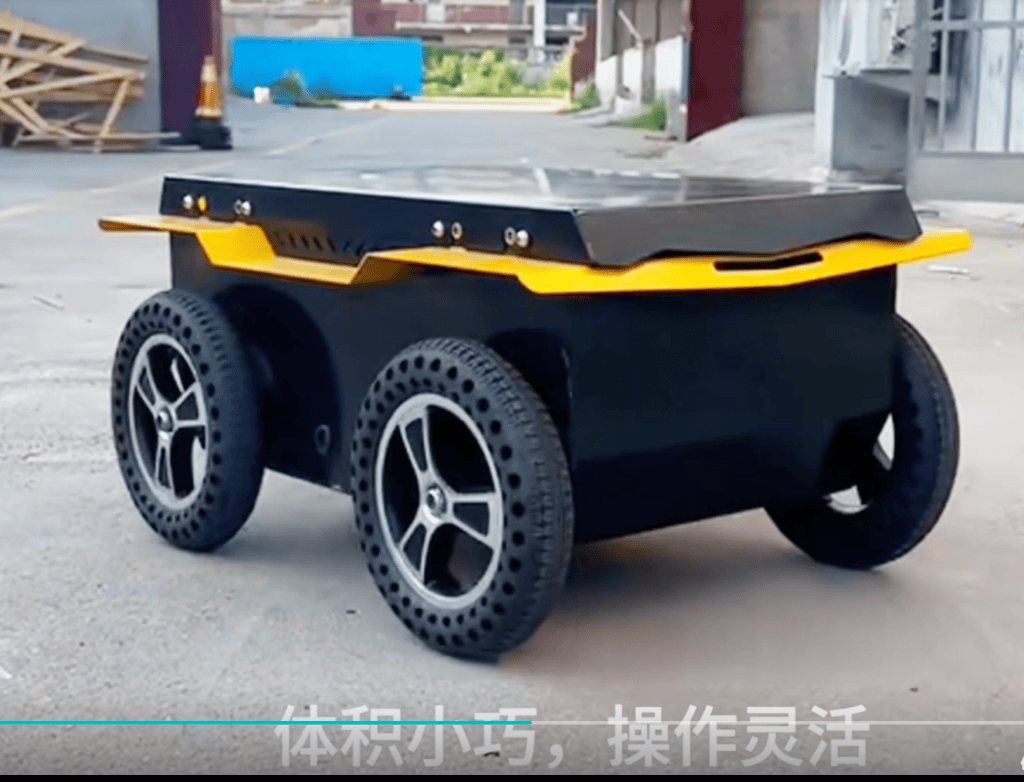
The core advantages of 4WD platforms are efficiency and flexibility.
- Higher travel speed
- Lower energy consumption
- Better for long-distance operation
Ideal for:
- Campus and industrial parks
- Autonomous logistics
- Orchard inspection
- Autonomous following transport robots
Structural Advantages
- Simpler maintenance
- Suitable for long-term operation
- 4-wheel steering improves maneuverability
Main Problems with 4WD Wheeled Robots
The biggest issue is traction loss.
- Wheels easily slip in mud
- Wet grass can cause side sliding
- Soft ground reduces load-bearing stability
In many situations, the problem is not insufficient power, but inadequate traction between the tires and the ground.
There Is No Universal Answer — Only Scenario Matching
| Application Scenario | Recommended Solution |
|---|---|
| Mud / Mountain Terrain | Tracked Chassis |
| Orchards / Industrial Parks | 4WD Wheeled Chassis |
| Long-Distance Transport | 4WD Wheeled Chassis |
| Extreme Complex Terrain | Tracked Chassis |
| Narrow-Space Steering | 4-Wheel Steering |
| High-Speed Mobility | Wheeled Platform |
Why More Companies Are Choosing Custom Robot Chassis
- Insufficient ground clearance
- Oversized turning radius
- Incompatible tires for terrain
- Insufficient payload capacity
- Weak environmental protection
Standard platforms often struggle to adapt to real-world environments, which is why many projects eventually require custom chassis development.
The Real Challenge: Long-Term Stable Operation
The hardest part of outdoor robotics is not whether the robot can move, but whether it can:
- Operate reliably over time
- Adapt to complex environments
- Handle different terrains consistently
- Work continuously without failure
True outdoor capability is not about demonstrations — it is about stable long-term operation.
Looking for the Right Robot Chassis for Your Project?
We support custom tracked, 4WD, and 4-wheel steering robot chassis solutions for outdoor applications.